I don't know if I'd recommend it, but it was kind of fun.... It all started with Rhiannon's birthday walk and the fact that I'd left my shoes at the bottom of the path below the mesa we live on. And the huge storm the night before that had washed away said shoes. I like going barefoot, it helps me feel my connection with the ground and plants more intensely and so I often traipse barefoot through the canyon. But this is the time of year when the stickers are reproducing like manic bunnies and you can't see the ground through the Sunflowers anyhow. So I was hoping to have my trusty green chaco sandals to make the trek downriver. I managed to find one sandal lodged in a rain-tangled mat of Nettles and Four O'Clocks, but just couldn't find the second one.
Since there was no point in limping downriver in a single shoe, I proceeded barefoot. Through the Nettles and Willows we went, Rhiannon holding a large sprig of Mugwort in front of her like a beacon (in case she got stung, she would chew up a wad of Mugwort and spit it on the stung area and be helped nearly immediately). I was very careful, dancing around the baby Nettles coming up through the rotting leaves, and bending at funny angles to avoid being sideswiped by the tall swaying seeded Nettles. Nevertheless, by the time I got to the other side of the Nettle patch, my feet were quite tingly and Rhiannon, even in river slippers, had howled at least once at the indignance of being stung.
The upshot was that I'd gathered lots of Nettle seeds in the slow walk to the other side. Rhiannon helped, also barehanded. We could be crazy, but we both hate the hand suffocation of gloves for plant work (they're very lovely for using a shovel or a chainsaw but not so good for working with living beings IMHO). We also managed to gather the most gorgeous Evening Primrose flowers from the midst of a huge Wild Rose bramble. We even swam the large muddy river together, me with a tight grip on the little Otter's hand! We had the loveliest ramble through the Sunflowers, Mugwort, Yarrow and Sage.
We did take the path home AROUND the Nettle patch though. My fingers are toes are still tingly.
Sunday, August 5, 2007
Walking Barefoot Through the Nettle Patch

Saturday, August 4, 2007
Another Gratuitous Elderberry Post
Everyone, or nearly so, in our small village has a terrible hacking, icky cold. All of us here at the Sanctuary have been a bit run down and short on sleep so it was no surprise when Loba woke up yesterday morning with a sore throat, low grade fever, muscle aches and copious phlegm and other face fluids.... She was miserable and overtired and begging for something to make it go away. First, I assigned her to extra sleep, instructed her to pour Fire Cider on everything she ate and drink lots of Ginger tea to enhance the body's own virus fighting techniques of fever and sweating. She also ate easy to digest foods in small amounts in order to not further tax her system. AND, I dosed her up good with Elderberry Elixir, not that I don't love Elderberry syrup, but I have found time after time that Elderberry is MUCH more effective when not heated in any way... my two favorite ways of preparing are the Elixir (see recipe below) and a honey paste with whole dried berries ground into raw local honey. I also had everyone else in the household start sucking down Elderberry Elixir.
And sure enough, after a good solid nap, and six or so doses of Elderberry she started to feel much much better. By the time she went to bed last night, she mostly just had some bodyaches and extra face fluid. By this morning, she just felt a bit run down and tired with just a little extra phlegm. I expect she'll be all better by tomorrow morning. I want to point out that the average run time of this particular virus on other people in the village is at least a week, often with bronchial complications. And, none of the rest of us caught it. I started to feel a little bit off with a sore throat yesterday morning, but by the afternoon, I was fine.
To top it all off, Elderberry does not simply stimulate the immune system, which would make it somewhat dangerous to those with autoimmune disorders or certain other chronic diseases. Rather it modulates the immune system to more appropriately respond to environs and circumstance. It also disarms the virus and helps it flush through body quicker, while strengthening the mucus membranes, supporting the body's natural fever mechanism without overheating, improves energy and stress handling AND last but certainly not least, it tastes great too.
I have tons of the Elderberry stories, I like this most recent one especially though because she was already sick, most of the time we just prevent the virus and never see many symptoms of it. Here, Loba was clearly manifesting signs of the same virus that was running around town.
If I had a snake bite, you bet I'd reach for the Echinacea. But for viral afflictions and general immune support, there's no better herbal ally than the bounteous and lovely Elder!
As an aside, I don't think that averting a virus is always the best course of action, sometimes we just need to get sick so we can spend a day in bed. Even so, I think Elderberry is a wonderful supportive therapy. Listen to your body and act accordingly.
Elderberry Elixir
Pint Jar
1/2 ounce of dried Elderberries
appr. 1 Pint Brandy
appr. 1/2-1 Cup Food Grade Vegetable Glycerine or Raw Honey
Place the berries in the jar, cover the berries with Brandy and then add Glycerine/Honey and Brandy to taste until the jar is full. Use at least 50 percent Brandy by volume in the jar to properly extract the Elderberry's healing qualities. You can also had a pinch of fresh Ginger, dried Calamus, Osha or some other warming circulatory stimulant to the mix for add benefit. I also always toss in a small handfull of dried Rosehips for good measure.
Take 1/4 - 1/2 dropperfull of Elixir every two to three hours at the first sign of illness. You MUST take the Elixir frequently rather than having a bigger dose further apart, it just won't work that way. Use the same dosage if you are actively ill. For a general preventative dose, I suggest 1/3 dropperfull every four hours or so.
Be sure to rest extra as well, the Elderberry has a much harder time with your immune system if you're really worn down. A little extra sleep will increase its benefits tenfold.
Update: I realized that I forgot to add to my recipe that I usually let steep for four to six weeks before using, and then I usually don't decant until the jar is almost empty.
Friday, August 3, 2007
Blood Knowledge, Plant Dreams and Remembered Wisdom: A Rambling Exploration

My family, both sides, came from the Appalachians, and before that from Scotland and before that from Northernmost Europe.... there's something of those people still in my blood. A bit of melancholy, a lot of storytelling and a deep love of forest and river. My mother played the fiddle, and sang those old sad songs so filled with longing and love, all underlaid with the haunted feel that my wandering ancestors carried with them from land to land to land.
Here in the Gila, I'm the farthest piece of my family's roving migrations. The only one who's made it West, who's made it, once again, to the edge of civilization and story. And though I feel at home in these cave-riddled mountains unlike anywhere else, I still have a few of those songs, and many of those stories in my bones.
My love once told me I must have been birthed from the moonlit flowers of the night blooming Sacred Daturas, and I am indeed born from this land of red dirt, crystal studded cliff faces and rambling red hipped Roses. Still, I smile when I hear an old song about the hollers of the deep hills, or a soaring Sami joik that reminds me of blood and bone, my ancestral mothers and all the knowledge that has passed through their bodies into mine. Wisdom of plants and wildness and healing. And though so much of these knowings have been scattered to the wind, just as my people have been, still a few roots have been left to my basket. And to these, I find myself adding newfound knowledge inspired by direct revelations from the plants and also the old teachings of the people I know live among, the recipes and ways of the Hispanics and the Native peoples, as well as the generous stories of the many healers, wise women and plant people that pass through this Sanctuary.
My mother knew the magic of Mulberries and Shepherd's Purse, my first teacher passed on to me the nourishment of Dandelion and the land itself spoke to me through the clear voice of the Stinging Nettles. The prairies of Missiouri, the ridges of Virginia, the seaside hills of the Northwest, the valleys of Pennsylvania and the canyons of New Mexico have all given me the insistence of Yarrow, Violet, Watercress and Wild Mint, teaching me the common language of weeds and wild things.
The thread underneath all this rambling is that healing with plants is, if not a birthright, at least a birth blessing from the Earth, our ancestors and the plants themselves. In every generation of human and flora, the ground gives a new call to the herbwives and rootsmen, birthing them into the community healing and wholeness. As I teach our daughter (who incidentally seven today) the names of each herb and show her how to get to know them, she blooms with memories of always "knowing" how to grind dried berries on the metate or how to gather the seedpods of Evening Primrose. She sings to the plants on the river bank, and carries the remembering of woman, plants and healing a generation further, renewing the sacred bond and promise we each hold.
Today, Rhiannon and I will take a long walk downriver to play in the surging muddy water, to gather Nettle Seeds and Sage from the forest edges and to listen to the way the sweet song of the Canyon intertwines with the melodies or our bones.
note: I'll soon be in the process of re-labeling each of my many posts and re-organizing a bit in order to make cross referencing easier for everyone.
Wednesday, August 1, 2007
Wild Canyon Grapes - Blogparty

I'm just resurfacing from co-teaching an incredible and moving four day workshop on Earth Path Shamanism. I don't think any of us could have predicted the power and profound shifts that occurred for nearly everyone present, and I'm still a bit overwhelmed by my gratitude to describe it fully. I will hopefully do a post about it before too long though.
I was so happy to see that Rebecca's decided to wait until tomorrow to post the blogparty, since now I actually have time to do at least a small post on berries.
My berry of choice at the moment is our Wild Canyon Grapes that are just now ripening, the picture above shows fully ripened and ready to eat Grapes, yum!
We also eat Grape leaves year round, both fresh and also preserved in a brine during the Winter season. Grape leaves are wonderful medicinally for taking down all kinds of swellings when used externally (fresh leaf poultice) and as an amazing fertility tonic when used as a dry plant infusion (especially combined in a regimen with Ambrosia root/leaf tincture). You can chop up the leaves and throw them in nearly any stirfry, stew, sandwich or other savory dish. When brined they provide a mineral packed green tang to as well. I think they're especially good with wild salmon or a hearty Elk stew.
The berries make AMAZING syrup, jam, wine and tincture.... While I don't really care for domesticated grapes at all, I love the complex wild flavor of our Canyon Grapes, they taste a bit like Oregon Grape berries and a bit like Elderberries: sour, sweet, refreshing and incredibly nutritive. I use Wild Grape tincture as a bioflavanoid rich blood tonic for those recovering from general debility, digestive trouble, anemia and other systemic weakness. Small doses of the wine made with raw honey or evaporated cane juice can also be used in the same way. If alcohol doesn't agree with you, another method is a syrup made with Wild Grapes and Blackstrap Molasses, add a smidge of Rosehips and Elderberries and you'll have an all around nourishing tonic.
I'll try to post at least one Wild Grape medicine recipe in the next month as I try out some ideas during this harvest season. Yum!
Sunday, July 22, 2007
Herbal Tidbit: Evening Primrose for Wounds, Stings and Bites
Much of the ethnobotanical reports about Evening Primrose have to do with it's purported prowess as a wound healer. Having used it extensively in the last few months, I'm here to tell you that the reports are true! I've used tincture (flower, bud, seedpods, leaf and root) on infected wounds, venomous insect bites and stings and even a few rashes with wonderful results. The redness clears, everything heals up without a fuss and VERY rapidly. It's really quite impressive, and is now up there with Cottonwood, White Sage, Rose, Yarrow and Plantain as my favorite first aid plants for infection, venom, irritation and slow healing.
Next step is to infuse into an oil for salves....
As a side note, these healing properties also seem to work very well internally for GI problems as well, as one would expect of an herb with such an affinity for the digestive system. A lovely plant.
Saturday, July 21, 2007
Every (Wo)Man’s Adaptogen: Nettle Seeds & The Adrenals

I’ve always been a bit intrigued by adaptogens (SUCH a trendy word), but the fact that they tend to come from far away lands combined with their often (for me) over-stimulating effects have kept me from using them very much personally. I do occasionally recommend Ashwaganda or Eleuthero root to others, but generally stick with my local allies in my practice. But I’ve been keeping my eye out for local nutritive tonics and adaptogens. It’s fairly unusual to find such a plant in the Gila, most of these plants seem determined to keep us cool, calm and disinfected (I’ve never met so many anti-infective plants in one place before!), we do have Wild Licorice here, but even that tends to run a bit to the bitter, cooling side in this ecosystem. And lately, people have been calling Nettle an adaptogen.
Now, I’ve loved Nettles for a long time and I’ve used her medicine in all sorts of ways, as a nourishing mineral packed infusion, as a vibrant bang of green tincture, as an itch soothing salve, as the worlds best green, as a garden fertilizer and even as an aid to awareness when I’ve obliviously stepped into her midst. Lately, I’ve been focusing a lot on her energy in soup, tincture and infusion form as an aid to my struggling adrenals. Nettles in any form taken internally seem to be an excellent aid in mineralizing the body, boosting energy, regulating blood sugar levels, calming allergies, draining dampness (water retention etc), reinforcing the immune system and even helping heal kidney and bladder problems as well as myriad other uses. What more could one ask for then? And yet, Nettles has even more to offer, much has been reported of late in its ability to treat BPH and severe Kidney dysfunction. Recently, Darcy Williamson wrote of an formula to be used in painful childbirth of two parts Nettle root to one part Nettle seed. She uses a tincture of fresh root and fresh seed for her preparations.
And yet, there’s more. About a year ago I read Henriette’s wonderful blogpost on using Nettle seed as an adrenal adaptogen, and then I saw Jim McDonald’s piece on using Nettle seed tincture for stress, and I thought to myself. “I NEED some of that stuff” so I’ve been pacing around waiting for the Nettles to come into seed this season. And here they are! About two weeks ago I went and gathered a handful of fresh nettle seeds, I carefully rolled them around and separated them from the the other plant bits (and hopefully broke all the stinging bits) and ate a pinch. I felt rather like I’d ingested some high quality amphetamines, heart racing a bit, a strange zooming sound in my ears and an overall semi-jittery “high” feeling. Nice, if you’re into that kind of thing but not what I hand in mind. Ryan Drum reports that a decoction made of the fresh green seeds taken to excess can cause one to experience days and nights of wide awakeness. I believe it :D
Then, Rebecca Hartman pointed out to me that perhaps there’s a difference between green and dried seed since she’d never felt overtly stimulated by her Nettle seeds. So hmmm, I spread my Nettle seeds out and waited for them to dry. Then I tried a pinch of nice dried seed, tasty. And no zooming sound! Instead, I felt rather rejuvenated, like I’d had several extra nights of good, deep sleep, and miracle of miracles I no longer nearly pass out every time I stand up from bending over or sitting down (incredibly inconvenient for gardening or wildcrafting, one second you’re happily plucking flowering Skullcap tops, you straighten up to check out an eagle overhead and the next minute you’re on your face in the dirt, ugh) like I have for oh, the last ten years. One pinch of Nettle seeds lasts me for about four to five hours I think, and banishes that buzzy, overheated, exhausted feeling I’ve been living with for so long (no matter how much sleep), as well as really really helping the insane carb cravings I’m prone to (being allergic to gluten and not eating many sweet things, this can be a problem). I haven’t yet had the chance to experience the effects over a long period of time, but I expect (in the way of Nettle) them to be nutritive and to build adrenal strength over time.
I’m not sure if I’ve ever taken any herb or food that gave me energy without worsening my chronic shakiness or heart palpitations (my name is Kiva, and I’m an adrenalholic, heh), so I was very impressed to find this quality in Nettle seed. It’s not replacement for proper nutrition, lifestyle changes and such but it’s certainly an amazing adjunct to these treatments. It doesn’t seem like a good idea to take with significant amounts of caffeine, but I haven’t tried it.
Other herbalists seem to use more towards a teaspoon of dried seed as a dose but a pinch does me very well. I’m excited to tincture the seed as well as making a honey paste/pills (a la Henriette) for further versatility. I can totally imagine a really lovely Nettle seed honey paste made with a wee bit of bee pollen, a smidge of cinnamon and a sprinkle of powdered Elderberries and Rosehips for an overall daily tonic, yummmm.…. One could add a bit powdered Cacao, unrefined Coconut oil and homemade Hazelnut butter for special occasions. Nettle seed truffles anyone? Coming right up ;)
Something I have done that’s just lovely is ground dried Nettle seeds, blended with ground Kelp, Sesame seeds, Coriander, Cumin and a bit of Sea Salt: the best seasoning ever!
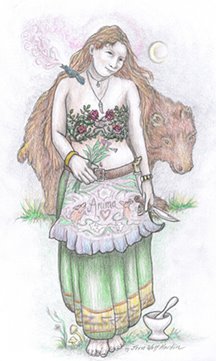
Oh, and that very lovely picture to the left is the birthday portrait Loba did of me that I promised to post! And to think, before I introduced her to watercolors, she claimed she couldn't paint!
Wednesday, July 11, 2007
Happy Birthday to Me!

Today I turned 27! To celebrate, Loba, Rhiannon and our intern, Kyra, climbed the arroyo to seek out the (hopefully) ripe Gooseberries. Much to our delight, about thirty percent of the Gooseberries were indeed ripe. So into the brambles we went to gather the tart black berries, between the four of us we managed to gather a couple pints. In the process, we also managed to get plenty scratched up and very hungry.
We wandered a bit further up the wash to find a shady spot to eat our wild salmon & egg salad, blueberry pudding and apples. There's something very magical and special about sitting on water polished volcanic rock, surrounded by a dozen varieties of butterflies, with stone walls enclosing us like a womb and a bright strip of sky streaking overhead.
Back home, we made Gooseberry-Pear Pie with an Almond Coconut Crust and Pear-Peach Cream on top to have after a so fulfilling meal of Nettle Stew with Wild Elk meat, Butternut Squash, Coconut Milk and Ginger, mmmmm.
Both Loba and Wolf drew me beautiful portraits as gifts. The one above is by Wolf, I just love it! I'll post the equally beautiful one by Loba sometime soon.
K, back to catching up after a day of fun! A perfect birthday.
Sunday, July 8, 2007
Wild Women's Gathering 2007
 Here we are! Happy Wild Women getting ready to sing together and howl at the moon. I'm there in the middle with the brown dress, Loba to my right and our apprentice Annie to the left. Our new intern, Kyra, is to the far left in the pretty pink peasant blouse.
All of the women were so special, and this Wild Woman's Gathering is certainly the best I've ever co-lead with Loba and may in fact be the BEST Gathering ever in eight years!
Together we ground cacao, cardamom and chili by hand on an ancient Mogollon metate, we made molé, tamales and special spiced sauces for around-the-fire chocolate delights. And we cried sweet tears of both grief and joy on the warm summer earth as we shared and learned, danced and laughed. We swam like otters in the beaver pond and gathered medicinal plants on the river bank. 
Here we are cuddling up, with Rhiannon wrapped around our new student, Jenya's arm. Our youngest Wild Woman at thirteen, Roya is grinding grain on the metate and Loba and I (nearly invisible) are cuddling our dear friend Roxanne, who drove a huge distance and brought us many yummy gifts. In fact, all of the women who came brought delicious treats to contribute to our communal feasts.
And here's lovely Ellen in the red shirt singing beautifully. We all came together and wrote two new songs around the fire, complete with harmonies and four part rounds! The two women on the far right are Sarah and Sandy, both from the Pacific Northwest. Sarah has been coming to the Canyon for at least six years, and brought her beautiful daughter Roya for her first ever WWG! Sandy came to experience the wildness of the Gila and went home with a new sense of connectedness and authentic purpose.
Monday, June 25, 2007
A Walk up the Arroyo: Monarda, Chokecherry, Gooseberries & Saskatoons

Loba and I woke up early this morning to prepare a picnic lunch to take up the arroyo on a berry picking adventure. We were hoping for ripe Gooseberries and maybe even a Saskatoon (Serviceberry, Shadberry, Juneberry or whatever else you'd like to call it) or two.
In the early morning the air was still chilly and quartz studded boulders that make up the arroyo floor were cool and smooth under our feet as we made our way up from the river into the mountains. Brilliantly colored Butterfly Weed was still blooming profusely every which way we looked, certainly its most prolific year in a long time. I can't wait to harvest a good batch of root this fall! Lavender to fuchsia Monarda blossoms were exploding on both sides of the rocky trail, some of them plants nearly four foot tall. Well, we just couldn't resist and harvested armloads and then bag fulls of richly scented flowering tops. As we walked we noticed we felt euphoric and a bit sleepy from the relaxing effect of the Monarda volatile oils. Also known as Bee Balm, the plants were covered in bees, hummingbird moths and butterflies of all shapes, colors and sizes.
Further up the wash, we discovered that our coveted Gooseberries were not yet ripe, but still swelling into fat green balls of goodness, when completely ripe they turn black purple and tasted like grapefruit mixed with currants and grapes, so yummy! There were a couple dozen black ones hanging from the the prickly bushes and I expect that the rest will be ready in about a week. In the meantime we devoured all the ripe ones in a single burst of bliss, there's really nothing better than ripe wild berries.
Even higher, we stopped for a little lunch of berries, eggs, homemade sauerkraut, rosemary sweet potato salad and Monarda pesto, mmm. And then, we discovered the motherload. Near the top of the arroyo where we once found a sun bleached bear skull and where the Oregon Grape Root and Mountain Valerian grow, we found half a dozen Saskatoon trees weighed down with green fruit, red fruit and nice ripe blue purple fruit. Now, we have plenty of Saskatoon trees here but generally the doves, bears and other critters get to them long before us, so what a treat to stumble upon so many ripe and waiting treats.
Now, if you've never had a Saskatoon, you just need to go out and find yourself one. They look just like high bush blueberries, complete with the bottom crown that blueberries have. They're fat and juicy and taste very very similar to blueberries with an almond crunch at the center, where there's chewy little seeds that are a treat all of their own. They leave this lovely, amaretto aftertaste in your mouth that makes you wander madly through the forest searching desperately for MORE.
We gathered all the ripe ones we could reach which was really only a few cups of berries, but for here, that's a LOT of any kind of berry. There's green ones that should hopefully be ripe just about the same time we come back up for the Gooseberries next week. I also harvested some small branches and bark, as Saskatoon was a common remedy among the Ojibwe and other tribes for pregnant women to prevent miscarriage either as a general pre-natal tonic as well as after a traumatic even or injury. It was also sometimes used to ease childbirth or as a general tonic or tea. Those uses open up a whole realm of possibilities for applications as a woman's reproductive tonic. I'm excited to experiment a bit with this plant and get to know her better. And as with many of the sweet, pleasant tasting types of berries, Saskatoons can be used as an effective and tasty blood tonic for pregnant women or anyone wanting to build blood and increase their intake of whole foods nutrition. And being a less astringent member of the prolific Rose family, they no doubt contain copious amounts of antioxidants and other healthful bits.
Back down the arroyo a bit I found a Wild Cherry tree attempting to take over the pathway so harvested some branches for bark. By the time we reached the spot where the rocks spill out into the river, the sun was high and we were unbelievably hot, so we headed for the beaver pond for a nice swim before returning to the homestead to sort and prepare our bounty. And to find out the prime ways to preserve our luscious Saskatoons!
Oh, and I couldn't help but pull the purple flower petal bits of the Monarda flowers off their bases and pack them into a small jar where I poured raw desert wildflower honey over them, stirring them with a chopstick until the honey was well distributed through the flowers. I'll let these steep for a few months, and save this precious substance for Winter chest colds, sore throats, respiratory difficulties and also for use a powerfully antibacterial and healing wound dressing for burns and infections.
Saturday, June 23, 2007
How to Survive a Summer in the Wilderness: Remedies from a Thorny Land
This started out as a simple post on Summer Skin Remedies for this month's blogparty but somehow dramatically expanded... I also have a previous post on treating injuries that is in a similar vein.
Sunburn: I haven't found anything better than Rose petal vinegar, diluted 1:4 in water and applied as a fomentation every few hours. It usually takes the heat and pain out very rapidly. The next step is Prickly Pear gel (or aloe) application and as the skin begins to heal and then a moistening, healing salve of White Sage, Elder leaf & flower and Plantain. Do not apply oils or oil based products to any burn that is still hot, it will only hold the heat in.
Burns: First, cool the area with lukewarm to cool water (never never never ice). Then apply diluted tinctures of Rose, Cottonwood and White Sage (or Monarda). Lavender essential oil (neat) or diluted tincture will also work well. Later on, compresses of Mallow and Elderflower can be very soothing. When all heat is gone from the skin then you can use a salve of Plantain, Sage and Cottonwood to speed healing.
Spider and other venomous, itchy bites: Plantain & Yarrow spit poultices are great here, have the person make their own poultice and ask them to swallow the leftover juice in their mouth as that will significantly shorten the reaction time. Tinctures can work if fresh plant isn't available. If it is a serious bite, add Creosote bush internally and externally, amazing stuff for bite and sting reactions. Osha can also work to slow allergic reactions to venom. For more minor but painful bites, like those of ants, try Evening Primrose or Rose tinctures externally, if they start to swell eat some fresh Yarrow leaves or take a few drops of tincture. For itchy, evil mosquito and horsefly bites try Wild Rose Petal tincture.
Poison Ivy: First, get all that volatile washed off with soap and water. Then, apply diluted vinegar or tinctures of Mugwort (make sure you don't have an Aster allergy first of course), Plantain, Yarrow and Rose leaf/petal. Oatmeal, Mallow and Rose petal baths can be helpful too.
Random rashes and contact dermatitis: Mugwort, Alder, Yarrow & Elder flower applied any way you like.
Swimmer's Ear: For just about any ear infections I use a couple drops of Elderberry/Mullein flower tincture or oil depending on whether condition needs moistening or drying. Of course, don't stick anything in your ear if you suspect that the eardrum might be perforated.
Sprains, Strains & Sore Muscles: Some people suggest ice but I try not to overcool the area. Instead I usually rub the area down with oils of Goldenrod, Rose, Cottonwood & Comfrey (or any of these singly, depending upon the situation and what you have available). Poultices, fomentations and baths can all be used as well. Mugwort is another fine herb for this purpose, gets the chi moving and is very healing. And come to think of it, Evening Primrose and Monkeyflower also work nicely here. Use Cottonwood, Evening Primrose and your nervine/antispasmodic of choice internally if there's pain and spasms. You can use Prickly Poppy internally if the pain is very bad.
Wounds, cuts & scratches: The possibilities are endless. My favorites are Sage, Rose, Elder leaf, Mallow, Plantain or whatever else is around. Mugwort is probably my most frequently used plant on any minor injury, bite or strain. Goldenrod and Monarda are just lovely too.
Splinters: Plantain, Mallow and Pine Pitch are my favorites, just make poultice and tape it on after cleaning the area.
Traveler's Diarrhea: Tincture or tea of Creosote Bush, Mugwort and Alder (and optionally, Honeysuckle). Yes, it will taste awful and yes, it will help. Accompany this with a tea of Mallow, Elderberry, Plantain and Rose to soothe your belly, balance your immune system and help restore a healthy balance of bacteria. Evening Primrose will also help heal the gut and stop cramping but may make you sleepy.
Heat Headaches: First, hydrate yourself. If you're feeling electrolyte imbalance you can take of the weird fizzy stuff (EmergenC) of you can dissolve some honey and salt in water and drink it, or have a Nettle infusion. An iced tea of Mallow, Rose and Elderberry can keep you cool and moist and prevent the whole thing. To ease the actual headache try some Lavender or Sage or Cottonwood. Sticking your head in a cold river helps a lot too.
There's much much more but I think this is a nice start, I'll probably add to this subject during the Summer as new incidents happen, focusing on one kind of injury at a time rather than attempting to generalize myself to death. It's so lovely to know that we're almost always surrounded by a crowd of healing herbs.
Friday, June 22, 2007
Tree Medicine and the Magic of Blisswort

Wolf trimmed some Alders and Cottonwoods the other day, and this small trimming resulted in a whole pickup bed full of branches. Now, I generally gather bark at the prescribed times of Spring and Autumn if only because the bark is generally easier to peel back then, but how I could I resist all that yummy resinous Cottonwood and silvery Alder bark just calling my name. Truth is, I couldn't, so I hauled tarps full of clipped limbs to the Medicine Lodge where I do most of my herb work and proceeded to sort and chop these mountains of trees. At the same time, my floor is already nearly covered with drying Quelites (Lambsquarters) so it's quite a squeeze in there right now, I can't even begin to reach my chest full of dried herbs or the shelves of tinctures and oils.
And I learned something, Narrow-leaved Cottonwood is much harder to dry than regular broad leafed Cottonwoods, they want to blacken right away rather than retaining their cool green crispness the way the other species do. Strange.... Nevertheless, I have successfully dried more leaf and bark that I know what to do with or even how to store. I think I need a new method of storing plants. This year has been bountiful that I have dried plants coming out my ears and all these silly little quart jars that are of no use in such a situation.
The Monarda began blooming yesterday, on the Summer Solstice, and I'll be taking a nice walk through the Arroyo in the morning to harvest the flowering tops and enjoy the lushness of the season.
The Woodrats are destroying my garden, but we won't go into that.... I'll just remain incredibly grateful for the immense amount of sustainable wildcrafting I'm able to do.
It rained today, a storm from the North so not a monsoon though it was full of hail and lightening that ignited multiple small fired in the Gila. The monsoons come from the South, from Tucson and I hope they'll arrive on schedule despite the unusual weather. Regardless of where the rain originated the plants thirstily drank it up. It's been very hot here, in the mid-nineties and oppressively dry. But the Canyon is so very green as a result of the many Spring showers so I can't complain at all, I just take my walks early before the heat becomes unbearable.
The Blisswort (commonly called Skullcap, but what an awful name for such a lovely plant) I harvested earlier this Spring has matured into a wonderfully green tincture full of the nerve restorative qualities of the dreamy purple-blue hooded flowers. Blisswort has, over the last three years, almost miraculously healed my deep fried nervous systems. The shaking the used to be nearly constant is almost gone, I haven't had an anxiety attack in I don't know how many months and my sleep is peaceful and regular. I only take one to two drops at a time and find that the extra bitter nature of New Mexico's Blisswort is extra beneficial for my stomach and liver, both of which have seen their fair share of trouble.
Taken in acutely stressful situation, a bad tension headache or stress induced insomnia, the plant will work her magic quickly, easing the tension from the body and allowing us to slip into a deep sleep. Used over a period of time, it will help restore the overall health of the nervous system from long term stress, drug or alcohol abuse and certain CNS disorders. It's bitter nature also helps clear heat, infection and toxins, making an extra useful nerve tonic for the Pitta/Adrenal stress person. I've also successfully used Blisswort for Shingles and Sciatica as well as many other kinds of nerve pain.
I especially like her combined with Blue Sage or Evening Primrose for general use, or with Rose Petals, Evening Primrose and Mugwort for delayed onset, crampy menses. But she works just fine on her own too, I suggest a fresh plant tincture as the tea is very bitter (at least from the plants here, I've heard that not all spp., are as bitter).
Oh, and Blisswort gives some people very vivid, intense dreams (not to say pleasant or unpleasant just very intense) so be aware of that if your prone to nightmares or the like.
This plant is one of my best friends and one I've used for many people and for a long period of time on myself, she is dependable and safe; a superb medicine plant that grows the world over.
Sunday, June 17, 2007
Another Morning in Paradise
 This morning I went to spend time in one of my favorite Canyon spots, a little place I call the Alder Throne, where many silver barked Alders come together on the river bank and their roots knot into a throne like seat right above the water. The tree trunks are deeply ridged and scarred from bear claws, the marks are bright red to rust color, depending on their age. A small Box-Elder Maple tree is growing under the Alders enhancing the green lushness of the spot while little Amraranth and Dragonhead plants peek around the corners.
I love these trees in all their fairytale glow and peculiarly scarred beauty, I spend quite a bit of time with my face buried in their ridged leaves and my arms around their silky trunks. The space between the trees and the water is hollowed out so that the river rushes through the empty space singing a sweet little song that echoes up to the throne. Across the river, there is a vibrant green wall of rushes and reeds, and the buzzing and chirping of cicadas, frogs and a hundred songbirds fills the Canyon morning.
I noticed a large branch had broken off of an Alder upstream and floated down the river to be half mired in sand, the leaves were still green and the bark still alive so I carefully gathered a basketful of twigs, leaves and peeled bark to dry for medicine.  On the way back to the cabin I gathered a few mulberries and wild currants, waving to the Silk Tassel bush, baby Grapes and Clematis as I climbed the rocks with my mouth full of ripe berries.
All this on top of a wonderfully tasty breakfast of green chile tamale and eggs, mmmmm. I love my life!
Thursday, June 14, 2007
Why I have Purple Feet :)
 I spent a good part of yesterday up in a Mulberry tree down by Saliz Creek. A friend of mine had asked me to come take a look at her Elderberry tree, and though I was quite perplexed at the thought of Elderberries in June I went on over to check it out. Lo and behold, it wasn't an Elderberry at all, but a White Mulberry (Morus alba) tree weighed down with sweet red-purple berries. So off went the shoes and up I went. To get the best of them I had to back my truck under the tree and climb up on top to knock down the big clusters since the higher branches weren't strong enough for me to stand on.
I couldn't help but eat a few (or so) while I was working, how can one resist berry juice dripping off their fingers anyhow, but I manged to save a few quarts to take home for pie and medicine. My fingers and feet are now stained a lovely violet color....
The picture is of a less ripe but beautifully red berry. We have about half a dozen White Mulberry trees right here in the Canyon, but unlike my friend, we don't have a predatory cat to keep the Rock Doves from eating all the berries before we can get to them.
These Mulberries make an excellent blood tonic for those with signs of blood deficiency (pale tongue, weak nails, breaking hair, dizziness, anemia can be symptoms). The whole plant, from root to bark to leaf to berry is all considered strongly medicinal in Chinese medicine. I've been working with this plant frequently this Spring and I'm still in the process of getting to know her particular magic.
And this morning for breakfast, there was pudding with cream, mulberries, bananas and butter roasted pecans, mmmmmm..... and a very sore hip from hanging from the tree by my left leg while trying to reach the uppermost berries, owww.
Monday, June 11, 2007
Butterfly Weed & Late Spring Storms: An Update
 There's been huge, tree breaking winds for the last three or four days and today it soaked the ground with a cold light rain. It was so chilly that Rhiannon wore her little fur coat and I shivered as I walked through the storm in a silk skirt and tank top. Strange weather, usually it's still and hot as an oven all June until the monsoons come in mid July. Usually, the plants are baked into gold skeletons until they're revived by the Summer rains... This year the Wild Sage, normally a monsoon dependent plant that blooms in August, is blooming today.
I drank Elderflower and Wild Mint tea and watched the storm dance through the Canyon, filling the rain barrels and soaking our little garden, urging the wild grasses to grow still higher, and the flowers to bloom in radiant profusion.
But the river is low from the aquecias sucking the water into fields and gardens and cattle drinking containers, it's sad to see the sandbars protruding like bones from the river's body, and I wait for the storms that will fill her to overflowing.
It's been a rich Spring, and I've put up quarts and quarts of tinctures, vinegars and oils.... I've dried I don't know how many pounds of Stinging Nettle, we've gathered wild Currants in the rain and we're waiting for the Wild Cherries, Saskatoons and Gooseberries to be dark and plump and ready to eat. Up in the high mountain areas nearby the Raspberries, Salmonberries and Blueberries are slowly growing in the deep shade of mixed Spruce forests. I love this place, the Gila's rich mixture of forest, grasslands, desert and riparian habitat. I love how the Cottonwoods and mutter and sing with morning breezes and the way the Alders shade cools me on even the hottest, stillest day.
The Mugwort is HUGE this year, about hip high in places just now, with many of the plants have brilliant red stems this year, full of fragrant medicine for the liver, belly, nerves and skin. I'll harvest and dry many pounds of her this year, to use for myself and my family and to pass on as a healing gift to others.
I've already deepened my relationship with several plants this season, especially the Salsify, Wild Honeysuckle, Silverweed, Corydalis, Sweet Clover and Evening Primrose and I'm looking forward to working with the Wild Hyssop later on the in the Summer.  And oh, the Butterfly Weed, I'm so in love with her... She's blooming everywhere right now, all shades of yellow and orange and gold. Every year she's so gorgeous I can hardly bear to harvest her. Otherwise known as Pleurisy Root, the roots of this radiant plant have been traditionally used in cold, damp chest conditions like pneumonia, chest colds, bronchitis and you guessed it, pleurisy. It can also work as a tonic for adrenalin stress (Pitta) type people with blood sugar problems, skin deficiency and pulmonary trouble. I've just begun to work with this use and can't wait to explore it further. As a side note, Butterfly Weed is a real pain in the ass to dig, at least around here, where it's roots work down into the most unknown crevices in hard, rocky ground. Expect to work for your Pleurisy Root! More on this one in the near future. Oh, and please note that this plant is on the United Plant Savers' "to watch" list so be respectful and don't harvest this plant until Autumn when it's already seeded and only gather from a well established, healthy stand.
Wednesday, June 6, 2007
Weedy Treatments for Liver Heat and Congestion with a Special Emphasis on Viral Hepatitis

These are therapeutic suggestions for conditions that can be caused by underlying constitutional imbalance, that are in turn aggravated by food allergies and deficiencies, lifestyle, environmental factors, solvent poisoning and diseases such as viral Hepatitis.
I personally feel that the overall constitution should be taken into account before treatment, which means if you are a airy, cold, dry and thin type of person who gets liver inflammation from alcohol abuse or the like you should use treatments specific to your body and your condition. The treatment picture below corresponds directly to the symptom picture (Pitta types with liver qi stagnation, liver yin deficiency and liver heat... how do you like that mix of metaphors?)
A Symptom Picture:
rapid, wiry pulse,
red to purple with redder tip, usually uncoated, often somewhat cracked tongue,
stomach upset with poor fat digestion, bloating and gas,
headaches behind the eyes or near the temples,
hot, itchy psoriasis and/or eczema,
irritation, moodiness and bursts of anger,
restlessness,
hot flashes and night sweats, hot palms of hands and soles of feet
frequent sighing (no, for real!)
insomnia,
dry, red eyes,
sharp pain in the liver area
hyper-immune symptoms,
Useful Approaches & Plants
First, address underlying dietary problems such as allergies. Many people with this particular symptom picture have gluten intolerance, try a six week elimination diet if in doubt. Nourish any nutritional deficiencies with whole foods and supplements as needed. Essential Fatty Acids, Magnesium, Selenium, Alpha-lipoic acid, E, C and B vitamins are especially important. It’s always best to get these through your diet but if you can’t or need to get a big boost in something like Magnesium where dietary sources may be difficult to obtain (or digest), make sure you get a very high quality supplement. I’m usually in favor of fairly high fat diets, but in the case of an impaired, inflamed liver, go light on the fat, and eradicate any low quality processed fat (margarine makes your liver scream, don’t do it). Preferred fats include clarified butter (or lacking that, unsalted, cultured butter but clarified unsalted butter is the best), olive oil, coconut oil and of course, fish oils.
People with an inflamed, congested liver often do better with several small meals per day rather than one or two large meals that are difficult for the liver to digest all at once. Especially for people with a Pitta type constitution and (often) accompanying liver inflammation and blood sugar problems, eating regularly throughout the day will help with general mood, digestion, skin and liver health.
This is not an exhaustive botanical list, but rather a compendium of the plants I’ve found most useful for this condition(s) over the last few years. Most are weeds or very common plants that can be found just about anywhere. A majority of the herbs listed are heat clearing, relaxant nervine, liver protective/tonifying and/or immune modulating.
Many Hep C regimens recommend the use of warming, immune stimulating herbs such as Astragalus, but in hot, acute, inflamed viral Hepatitis or any similar liver disorder it’s very important to use primarily cooling, heat clearing herbs(but always with a small amount of warming/stimulating herbs in the formula). Using Astragalus, Garlic etc., as primary herbs will simply aggravate the existing condition. Also note that uses listed are only those that pertain to this condition.
These herbs can be combined in various formulas as infusions, decoctions, tinctures and whole plant depending on your need and the nature of the plant.
The Weeds
Primary Tastes: Bitter and Sweet, with some Sour & Pungent
Primary Energies: Primarily relaxing and cooling, with some spicy Chi regulating herbs
Western Mugwort (probably regular Mugwort would work too, A. capillaris is commonly used in TCM for acute hepatitis and jaundice) - Bitter, pungent - Protects and cools liver and digestive system, moves qi and blood and relieves liver congestion in a big way. A primary remedy for Hep C with inflammation. Relaxant nervine.
Lavender - Bitter, pungent - Cools & relaxes the liver, moves qi, relaxant nervine. Relieves pain and depression related to liver qi stagnation.
Sage - Bitter, astringent, pungent - Similar to lavender in many respects. Cools liver, assists the body in fluid distribution, strong moves blood and qi, relaxant nervine. Relieves pain and depression related to liver qi stagnation.
Skullcap - Bitter - Relaxes and rebuilds in the nervous system, helps to mellow the moods swings and CSN irritability typical of liver inflammation. Stimulates gastric juices for a more relaxed effective digestion process, something of a big deal for many people with liver associated IBS.
Peach leaves/twigs - Relaxing and moistening, helps calm hyper immune response, good for nausea and stomach upset where an inflamed liver is the source of the problem.
Rose petals, leaves and hips - Astringent/Sour - Cooling, liver relaxing, blood moving, relaxant nervine, lymphatic
Dandelion root - Bitter - Bile stimulating, cooling, clears heat, relieves liver congestion (you’ll notice I repeat that a lot, it’s VERY important to keep the liver unstuck and moving).
Peony Root - Bitter, Sour, Sweet - Strongly blood moving and somewhat blood building, clears heat, relaxant nervine. Relieves pain and depression related to blood congestion.
Elderberry - Sour, Sweet - Immune modulating, stress relieving, gently relaxant nervine, liver nourishing as well as supportive to the whole body. Decreases liver related allergies.
Milk Thistle Seeds -Neutral - Liver protective Best prepared as ground seed and sprinkled into foods for this condition rather than tincture or even decoction.
Orange Peel -bitter, pungent- Moves stuck qi, especially liver qi
Evening Primrose Whole Plant- Neutral - Liver nourishing, relaxant nervine, supports liver health and heals inflamed stomachs. Useful for highly driven people with stressed out livers that have resulted in anxiety, GI troubles and eventually, depression.
Honeysuckle Leaves & Flowers -Bitter, Sweet- Strongly heat and infection clearing, lymphatic, helps with pain and anxiety.
Stinging Nettle Leaves -Salty- Nourishing, drains dampness, clears heat, assists with clearing up psoriasis, eczema and other liver related skin conditions.
Reishi -Bitter, Neutral- Immune stimulating, liver protective, adaptogenic, spirit calming, helps with insomnia, restlessness and anxiety often associated with liver inflammation. I make a long decoction (2 or more hours) in a Ginseng cooker and give separately from other formulas. Larger doses (8-10 grams per day) seem to be most useful in acute liver inflammation. Lower doses (appr. 5 grams per day) work well with chronic low grade liver problems.
Mallow Whole Plant -Sweet, Salty- Moistening, nourishing, immune stimulating . Very useful for chronic dryness and inflammation. Well help heal an overheated stomach and system. Also a nice overall tonic for the dry, irritated Pitta type person.
Licorice Root -Sweet- Adaptogenic, strongly liver protective, very useful for harmonizing other remedies in a formula, the contradictions for Licorice are rarely present in those with a hyperimmune constitution and liver inflammation, regardless, the amounts used in formula should not present a problem for most people.
Asparagus root -Sweet, Bitter- Moistening, cooling tonic for overall constitutional balancing. Helps moderate inflammation and gently increases liver function.
Thursday, May 31, 2007
A Fogotten Tonic Herb: Evening Primrose

I’ve done some forgotten herbs for this month with Monkeyflower and Wild Honeysuckle, and I think even Wild Rose has been a bit forgotten... there’s also the Alder post from last month. Yet I had a few more thoughts specifically about our lovely Evening Primrose and wanted to share before the month was over.
Oenothera spp.
Parts used: whole plant
Energetics & Taste: Sweet, sl. bitter, sl. spicy, sl. moist & neutral temp
Primary Actions: vulnerary, anti-spasmodic, anti-depressant, anti-inflammatory, relaxant nervine
Organ affinities: lungs, musco-skeletal, upper GI, liver, nervous system
Suggested Dosage: 1-15 drops of whole plant tincture up to 3-4 times per day, 1-3 tsp whole plant in infusion per day, 1tb of ground root or plant in honey as needed, 1-2 tb ground seed in flaxseed oil per day
Cautions: This is really a very gentle and safe herb at the proper dosage, but research suggests that the refined seed oil should be used with caution in epileptic patients or those who routinely experience seizures.
We’re blessed to have about six different kinds of Evening Primrose here in the canyon, but the most commonly used medicinal species are the upright biennials. We have two of those, one white that I haven’t keyed out yet and then a beautiful golden variety called Hooker’s Evening Primrose. This year the white species is especially prolific, carpeting meadow and roadside with a soft white luminosity that begins in early evening and continues through the night into the morning. Very much a moon plant, this beauty seems to shine with its own light in the dark, and when the petals are pressed, they become tinted with an iridescent rose blush. This is an energetic medicine for the solar plexus and heart, balancing receptivity with expression and allowing us to open fully to love without fear of rejection or betrayal.
Evening Primrose is most popularly known in its seed oil form frequently sold in health food stores for its high gamma-linolenic acid content. While I’ve seen the oil be very useful for many people, what I’ll be talking about here is the whole plant, including leaves, buds, blooms, roots and seeds.
In my experiences, I feel the plant most strongly in my nervous system and muscles, which become very relaxed but without affecting my mental state very much. To tell the truth, the first time I used it, I felt a bit like I’d been slipped a muscle relaxant when I took about 7 drops of the whole plant tincture. I had a hard time walking without feeling like a rag doll but I somehow also felt energized at the same time (I am very sensitive to nervine effects and experience has shown that it takes most people at least twice that dosage to experience such effects). Chewing on a bit of fresh root was distinctly relaxing but had less direct effect on the muscles. I’ve also seen the tincture be useful for severe menstrual cramps, it doesn’t always eliminate the pain but it can lessen it on par with more powerful and less safe herbs like the Nightshades. The tea/infusion is also useful for cramps but so far I feel that the tincture or whole plant in honey is the most effective for muscular issues.
A key word in the symptom picture of this plant seems to be irritation -- hyper sensitive nerves, muscles and mucus membranes that just want to overreact to everything often respond very well to this plant. William Cook notes that the properties combine:“some stimulation with considerable relaxation; acting on the peripheries of sensory nerves, relieving local and reflex excitability... It has proven useful in hyper-sensitiveness of the stomach with indigestion, uterine irritability, hysteria, hysterical vomiting, tenesmus, spasmodic cough, and other difficulties of reflex origin.”
David Winston has introduced the use of the leaves as a remedy for GI related depression, and it seems to me through personal experience as well as hearsay from well known herbalists like Paul Bergner, that GI problems are the root of many peoples’ depression, making this potentially an incredibly useful remedy.
Evening Primrose definitely soothes the stomach, especially in tea form, being relaxing, antispasmodic, slightly astringent and somewhat mucilaginous, very healing and gently tonic. This is an ideal remedy for dyspepsia with gastric inflammation, a large, coated tongue and an overall sense of gloom. It is especially useful where there is a spasmodic cough/asthma and/or pelvic fullness and reproductive irritation. Clymer wrote that it is indicated when a person had been consuming a bad diet over a long period of time that resulted in toxins accumulating in the digestive system. This kind of diet often negatively effects the liver as well, and Evening Primrose is indicated both in modern research on the seeds as well as through traditional usage of the whole plant for a debilitated or sluggish liver.
I believe that Evening Primrose is an excellent tonic for what Michael Moore calls Adrenalin type stress where the GI, liver, skin, reproductive system and kidneys tend to all be deficient but the nervous System and musco-skeletal are in excess which leads to eventual burnout and chronic digestive disorders, often accompanied by pelvic congestion. This is a gentle, neutral remedy that can be used over a long period of time without adverse effects. Certain species are more bitter than others and I prefer to use the non-bitter white flowering type here for most uses, and reserve the slightly bitter plants for more heat clearing, stomach stimulating purposes.
Matt Wood associates this herb with a rare class of medicines he calls balsams, that have such an evenly balanced blend of energies and tastes as to be nearly neutral and gently stimulate the solar plexus and revitalize the whole body. Other herbs of this class include Lemon Balm and St. John’s Wort. Note that both of these of plants, like Evening Primrose, are very useful for both anxiety and depression and significantly effect both the solar plexus and the heart. These are balancing remedies for the mind, spirit and body.
Outside of these tonic uses, Evening Primrose is definitely useful for simpler cases, such as any spasmodic cough, asthma, belly distress of varying kinds and causes, menstrual/muscle cramps, joint/muscle pain and all sorts of wounds.
A nice way to ingest the plant that I learned from Michael Moore is to grind the dried root (or whole plant) to a fine powder and mix with warm honey (Michael suggests boiling the root in honey but I prefer to retain the medicinal virtues of my raw honey), take by the tablespoon for sore throat, spasmodic coughs and so on. Especially nice for small picky children who whine about eating anything besides candy. Combine the Evening Primrose with Rose, Anise or Fennel and a tiny amount of Osha or Balsamroot for an especially nice syrup.Another trick I’ve learned from Michael is to take advantage of the nutritional GLA aspects of the seeds by grinding the seeds into a powder and blending with enough Flax oil to preserve and take a few tablespoons per day. As with all EFA supplements, I keep the container in the fridge (well, I don’t have fridge, so the pantry will have to do) to slow rancidity.
I’m infusing Evening Primrose flowers, buds and roots into an oil right now, I expect it will make a fabulous wound healing and muscle relaxing balm, and I’ll update you with my experiences later on. In the meantime, leaf spit poultices work very well for bites, stings, wounds and rashes.
References:
William Cook - A Compendium of the New Materia Medica Together With Additional Descriptions of Some Old Remedies
Matthew Wood - Admirable Secrets of Herbs, Roots & Barks: A Practical Materia Medica of Western Herbal Medicine
David Winston - an interview with Nature’s Path - The Quarterly Journal of the Association of Master Herbalists, by Gina carrington and Kelly Holden
Michael Moore - Medicinal Plants of the Mountain West
Tuesday, May 29, 2007
An Interview with Robin Rose Bennett: Wild Carrot, Fertility and a Vision
I wanted to share a new interview Jesse Wolf Hardin just did with Robin Rose Bennett, a wonderful Wise Woman herbalist who will be coming to the Sanctuary this August to teach an exciting herbal workshop! Interview With Robin Rose Bennett
Visionary Herbalist
by Jesse Wolf Hardin
Introduction: Robin has been a practicing herbalist for over 20 years, focusing on the spiritual and ecological lessons of the plants as well as the treatment of illness. What she is best known for is her rather extensive study of the wild carrot, particularly as an ancient and still viable means of natural birth control.
JWH) When is earliest mention of wild carrot (Daucus carota) being utilized for natural contraception, and what is the history of your own relationship to this special plant?
RRB) The earliest written accounts are about 2000 years old from ancient Greek medical writers such as Dioscorides, Scribonius Largus, Hippocrates, and Pliny the Elder. I imagine that women’s oral tradition regarding this usage is likely to be older still.
I first heard about it when I was in college in 1978. A young man showed me a bowl of bristly seeds and told me his girlfriend would chew one teaspoon of them within 24 hours after sexual intercourse and that it was effective for birth control. I was stunned! I began using Wild carrot seeds in 1985 after I’d completed an apprenticeship at the Wise Woman Center with Susun Weed. Susun’s first book included a paragraph about wild carrot for implantation prevention. Being a heterosexually active young woman in my 20s I wasn’t likely to forget having heard about a natural method with no side effects! By this time I was developing my trust in the plants and began to use it as my sole means of birth control. I began teaching about it over the next few years.
JWH) I understand that you can’t prescribe this, but only cite cases for women to consider in making their health and fertility choices. But the reports are amazing. Briefly describe the double-blind survey you took, and the results.
RRB) When I lived in NY City I did a grassroots study with 13 local women, 10 of whom had established their fertility through previous pregnancies. The women were given monthly calendar charts to note their cycles of ovulation and menstruation and when they had sexual intercourse and when they took their wild carrot seeds. This small study ended up with a 98% success rate over 13 months. I do want to clarify that this was not a double blind study. None of the women was given a placebo in place of wild carrot. Honestly I don't think I would have had too many volunteers under those conditions! Since then I’ve learned about even more effective dosage protocols. Wild Carrot is a great gift, a Goddess-send for women and their partners. That said, the life force is a powerful thing and no form of contraception is guaranteed.
JWH) It would take quite a leap of faith, to depend on this method, don’t you think?
RRB) I agree! And yet, we take leaps of faith all the time, don't we? Every time a woman trusts that the condom won't break or give her a yeast infection, or that an IUD won't cause heavy menstrual bleeding, a pelvic infection, or perforate her uterine wall, or that her birth control pills won't give her breast cancer later on, or even that she won't get pregnant using these devices or drugs, none of which have a 100% success rate at preventing pregnancy. I personally know of pregnancies that have occurred in women who’ve had their tubes tied! I envision a time when our daughters receive the plant wisdom of wild carrot from their mothers with easy trust (like a young woman today trusts her IUD or her birth control pill) because it is what her mother used, and what her grandmother used. The more generations that go by, the more natural it will seem to accept and trust a plant to help you choose how you want to direct your fertility and use your creative energies.
JWH) This would seem to be another way to empower women, by giving them conscious control over their fertility, without the side effects of birth control pills or the loss of sensuality in condom use. You believe in individuals taking personal responsibility for not just their fertility, but their well being.
RRB) I do. You can’t control fertility, though you can engage it and to a certain extent, direct it. This is true of healing, too. It’s about engaging the life force itself and that offers us a different way to look at health. Culturally we’re taught to conceive of healing and illness as if it were a military operation that we have to win, as if our bodies were against us from the beginning and we have to be armed and ever vigilant to prevent “them” from failing “us”. Even natural healers are prey to this conditioning. Growing beyond this perspective into a more compassionate and loving approach to taking responsibility for your well-being takes time and experience to see what works and what doesn’t, what actually supports healing. Cultivate a deeper relationship with your body, learn to listen to it and you will find that your body is wise, truthful, and its messages/symptoms are always rooted in love for you.
JWH) What is the role of medicinal plants, among our healing choices?
RRB) The medicinal plants offer us physical and spiritual nourishment. My teacher Keewaydinoquay said, “Of all the creatures of Earth the plants have remained truest to their original purpose, which is to give of themselves generously to all beings.” The plants are our elders and our healers. These healers know who they are, and what their purpose is. On a spiritual level what you are making part of yourself when you take a medicine plant into your body is that knowing, that wholeness. The plants and trees, and the weeds of the seas invite us back home to the Earth, to the living heart of Gaia. This then brings us home to the heart of ourselves, and that allows us to truly heal. Physiologically, the medicine plants match us on a cellular level and are able to be assimilated into the structure of our bodies more completely than nutrients that we ingest in any other form. They offer us primary nourishment for systemic healing, and tonic properties to restore or optimize the functioning of our body systems. The plants not only help us heal our physical ailments, they also help us to become more fully human. They subtly but surely help us reclaim our true nature of generosity, compassion, kindness, and joy.
JWH) Very well said. In the practice of Anima, we teach that healing is the restoration of wholeness, that we are inextricably connected to our environment, and that we need to treat (work towards the wholeness of) the natural world as essential extensions of our selves. I’d like to hear you describe the relationship between ecology and natural healing.
RRB) What is good for us is good for the Earth and what is good for the Earth is good for us. The clearest connections between natural healing and ecology happen when people learn to recognize, grow, and gather their own medicines because then the relationship between natural healing and ecology is experiential rather than conceptual. Indigenous and Wise Woman ways teach us that plants gathered with gratitude and respect share their best medicine, while those that are not asked for and gathered properly leave their best medicine in the Earth. We can’t just take the plants, make them “things” for our consumption without concern for their well-being, their abundance, their continuing healthy presence on the planet. The plants have to have healthy soil and water in order to grow and be of benefit to us, just as we need these things in order to grow and be of benefit to each other.
JWH) What is the role of the Wise-Woman – the Medicine Woman – in today’s society?
RRB) The Wise woman teaches from her own well of experience, walks her talk as truthfully as she can, and holds a vision of the sacred web of life. She freely commits to using her gifts in service of Gaia and all her relations. When you come for help with a physical and/or spiritual challenge, Nature, and especially the plants, are her allies in helping you heal yourself. The Wise Woman’s role is to help one who comes to her in a time of transition, not only to heal illness, but also to guide you to awaken your true nature, your full aliveness, to step into your wisdom, to own and develop your gifts and responsibilities as a human being. She helps you to awaken your physical senses and rekindle your direct relationship with all that is divine by guiding you to joyfully connect with Earth, especially the plants, flowers and trees. She is a mirror of the magic in the everyday and the power of self-love. What the Wise Woman offers her people today isn’t necessarily different than it once was, but extending the teachings out to as many people as possible has an urgency about it now.
JWH) Indeed, human societies have never been more in need of empowered women, rooted to the natural world and their own directed natures. How do you yourself stay intimately connected nature, and informed by the earth-spirit? Gardening? Time in a forest or wilderness?
RRB) Yes. I live in NJ and behind my home is a state forest I have access to, and I transformed my front lawn into my herb gardens. But, remember, I spent my first 10 years as an herbalist in NYC so I developed a certain determined mind-set to listen to and observe Nature. She’s there, even among the buildings and asphalt. I observe the plants and birds wherever I go. The weeds will wave to you from the side of the road if you pay attention to them.
JWH) Besides writing books and instructing apprentices, you also travel and teach, including at the Anima Center in New Mexico in mid-August. What kinds of experiences do they have?
RRB) Participants enjoy getting to “stop the world,” to encourage personal transformation and/or replenishment. A warm, supportive community usually forms quickly. We enjoy sharing weed walks, plant stories and medicinal information, harvesting, making medicines, planting, Goddess songs and dances, moving meditations, working with the elements, meditating with the moon, and creating joyous rituals for healing. There is often much laughter (and some tears) and we savor delicious, lovingly prepared foods. Guided meditations take you into sacred spaces, inside yourself, a plant, a stone, or even deep within Gaia herself. Sometimes we craft Spirit art. Always, we commune with the medicine plants and trees, the birds, insects, and animals, the water, air, and sun, helping us to awaken to the magic of every moment so that when the retreat is over we can take that magic back out of the circle into our lives, into the world. I’m excited and honored to be coming to work at Anima and am so looking forward to visiting your sacred land and working with Loba and Kiva Rose and the women.
JWH) All the world is inspirited and communicative, with every species having a unique story and lesson to share. What do you think the plants, and medicinal herbs especially, are trying to communicate to us?
RRB) The plants don’t speak as one voice, but essentially they “say” that they are here to help and guide us in healing ourselves. They teach that everything we need is already here. They enjoy being noticed, even admired, as well as being loved and appreciated and approached with gratitude. The plants are offering us a mirror of our own nature as human beings living in a web of relationship with everything around them/us. They guide us to be who we came here to be, both uniquely and as a species, and to share our gifts of beauty freely, for the benefit of all, as they do.
JWH) And if you knew that only one message would be heard by the majority of humanity, what would you personally hope to advise them?
RRB) We are being invited, cajoled, threatened, and encouraged to live from a new paradigm of love not fear, connection not separation, generosity rather than greed. It is obviously scary, but it is also exciting. There is a heartbreaking amount of deathing going on in our time and it will continue. However, just beneath the surface there is a great rebirthing happening from within people and it will become more and more visible over time. We are each more than we seem to be. The time we live in is full of promise and many people are feeling the call to fall back in love with life on Earth. If not now, when? Now is the time. Choose to renew and pursue your sense of connection with the immanent Spirit that is within everything on Earth for Earth holds the key to opening your heart to joy, and joy awakens your spiritual wisdom. You have to turn the key in order to evolve. You matter. There is only “us” and we are all inextricably intertwined.
Jesse Wolf Hardin is a founder of the earth-inspired practice of Anima, caretaking a restored river canyon where he coshosts folks for wilderness retreats, quests, and events like the Women’s Wisdom Plant Retreat with Robin Rose Bennett, Aug. 25-28: Anima Wilderness Learning Center, Box 688, Reserve, NM 87830, www.animacenter.org. For more information on Robin’s courses, books and events, please go to: www.robinrosebennett.com, or call (973) 728-5878.
Tuesday, May 22, 2007
Monkeyflowers in Heaven

Mimulus, of Bach flower remedy fame, is also a lovely wildflower and indigenous remedy... I've mostly used it for pain, externally on wounds, burns, nerve injuries and have been recently using it internally for pain as well, especially joint pain and neuralgia (a use gleefully taken from Kings American Dispensatory ).
This is an incredibly joyful little plant, and is proving to be an effective anti-depressant for those who feel the joy of life has completely left them, who feel terribly vulnerable and constantly anxious. These are flower essence indications but they're very accurate to the action of the plant. Monkeyflowers have a big spirit and just sitting with them can be uplifting and well, just plain fun.
I have a hard time picking the plant because they seem so animated and child-like that I can barely stand to harvest them. Thankfully, small doses seem to be very effective and so I don't feel I need to take very much.
Monkeyflowers like to grow near clean, running water. They seem to be fairly common throughout the West, especially in Alaska and New Mexico. Here, they thrive on the riverbanks, especially in wet Springs like this one. During dry years I'll only see a few here and there, but this year they're nearly everywhere even remotely damp, springing up like eager children to play in the sun and wind.
I'm off to the river to see the Monkeyflowers again!
Wednesday, May 16, 2007
Kiss Your Plantain!
Recently, an apprentice of ours was bitten by a tick on her arm. I've never ever ever seen a tick here and neither has Wolf, and he's been here nearly thirty years. But ah well, she pulled a tick off of her arm (inner elbow crease area), and the bite site proceeded to swell up, get a ring of red around it, become white and pitted in the center and cause her muscle pain in the surrounding area. Now, I wasn't home when this happened, I was in South Dakota. She was worried it might be lyme's disease. I've had no experience with Lyme's so I was worried too.
When I got home I looked at it and thought to myself, "hmmm, looks like an infected spider bite, where's the Plantain?" and said so too, but with the ring of red and muscle pain I was concerned and spaced out the Plantain. I looked at various medical picture of the bull's eye type rash that sometimes accompanies Lyme's, it didn't look anything like her red ring but some of the symptoms were the same. I printed off David Winston's excellent handout on Lyme and shared it with the apprentice.
The red was getting bigger and meaner looking, though she was using clay poultices and applying various antibacterial herbs like Melissa (the apprentice is an herbalist too). Next, I asked a good friend of mine, Ananda Wilson, about her Lyme's protocol since I knew she'd dealt with it several times, she also suggested a green plant poultice (she might have even said Plantain, damned if I can remember now) as well as other good plants.
She ended up going to the clinic and getting a Lyme test (which of course came back negative, those things are infamously incorrect and count on antibodies being present, which doesn't usually happen in the first month after the bite). The doctor insisted she take a two week course of very strong antibiotics. The apprentice reluctantly complied and got a bad bellyache despite lots of probiotics. The bite site didn't get any better, at all. If anything, it got redder and madder looking.
A week later, the apprentice started having strange tingling in her fingers and toes... Soon, any temperature change for her extremities (like river water on her toes or walking a long while) caused her excruciating pain and the tingling/pain was moving up her hands and feet. Well shit, thought I. Nerves or circulatory? We couldn't figure it out and were worried about Lyme related nerve damage. It wouldn't respond to nerve herbs though, so back to the clinic we went. Turns out she was having a rare reaction to the antibiotics and now had rapidly spreading vasculitis. They said that they hoped it would heal if she stopped the antibiotics. She paid her now $300 bill (who knew that you had to pay for vasculitis?).
So, finally, I walked down to the river and picked four Plantain leaves and told her to make a spit poultice and leave it on the still infected bite site overnight, repeat every night for four nights. And whaddya know? The infection is nearly gone, a quarter of the size that it was, no more muscle pain, very little redness. A couple more nights of Plantain poultices and I expect a complete recovery.
We're doing a flavanoid rich regimen for the vasculitis (rose, hawthorn, elderberry, bilberry and so on) which is also receding.
There's a lesson in this, isn't there? Not that one shouldn't get tested/treated for Lyme ASAP, one certainly SHOULD, it's a dangerous disease that can easily go agonizingly chronic. No, it's that one should listen to one's intuition... if we'd just used Plantain at the first sign of infection/redness, we would have been saved $300, stress and vasculitis.
Now, go outside and kiss the nearest Plantain leaf!